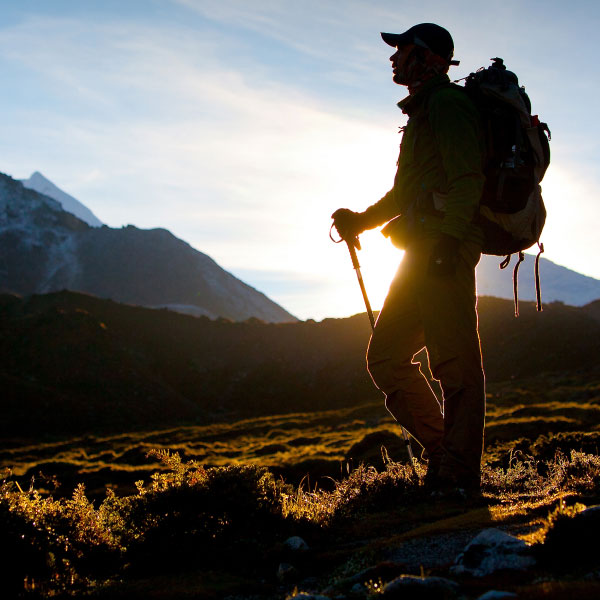

What Is Thru-Hiking? Continuity Over Stages
Thru-hiking means walking a defined long-distance trail from its official starting point to its end in one continuous journey. This definition implies committing to a route and following it day after day, without breaking it into sections spread across multiple years or seasons. Some thru-hikes are only a few dozen kilometers long, others exceed 4,000 kilometers—but what matters is not the distance, it’s the continuity. You start at the beginning of the trail and keep moving until you reach the end. Whether you hike NOBO or SOBO matters less than the commitment to completing the entire route.
Unlike traditional section hiking, thru-hiking is about staying in the flow. Rhythm matters more than speed. Progress comes from consistency, not peak performance. Zero days, shorter days, and breaks are just as much a part of the experience as long mileage days—there is no single “right” or “wrong” way to do it.

Discover the entire trail here and plan your stages
Go to the mapWell-Known Thru-Hiking Routes and Their Significance
Over the years, routes like the Pacific Crest Trail, the Appalachian Trail, the Continental Divide Trail, Te Araroa in New Zealand, and the Camino de Santiago have shaped thru-hiking culture. These iconic long-distance trails rank among the most important hiking routes worldwide. They cross entire regions, climate zones, and communities. Anyone who spends enough time on trail quickly realizes: the trail sets the pace, not the original plan.
Why People Choose a Thru-Hike
People decide to go on a thru-hike for many different reasons—and most of them are surprisingly down to earth. Spending weeks or months outdoors creates a depth of nature experience that is hard to find in everyday life. Nature is no longer a backdrop but a framework: weather, terrain, daylight, and seasons define the day.
Daily life simplifies quickly. It usually comes down to walking, eating, resupply, water management, breaks, and sleep. Many experience this reduction as calming and clarifying. The trail tends to reset expectations faster than you might expect.
Physical Reality: Demanding, but Rarely Extreme
Physically, thru-hiking is demanding but rarely extreme. The challenge lies less in intensity and more in endurance: long days, changing terrain, heat, cold, rain, or wind—all while carrying your gear. Over time, many thru-hikers discover not how fast they can be, but how adaptable their bodies are.
People without an athletic background have successfully completed major thru-hikes as well. Strength, resilience, and routine are built on the trail—not before it.
The Mental Side: Doubt, Routine, and Persistence
Mentally, the journey is often more challenging than expected. There are monotonous sections, tired legs, sore feet, wet days, and moments of doubt. Motivation fluctuates, plans fall apart. That’s part of the experience.
Many are drawn to long trails precisely because of this—to learn patience, flexibility, and persistence. It’s not about escape or performance, but about finding a different rhythm. Some even talk about a “post-trail void” after finishing a thru-hike—a sign of how deeply this simple structure can shape the way you think.
Traveling Slowly: The Trail as the Measure
Thru-hiking is one of the slowest ways to travel. Every kilometer is experienced on foot. Landscapes unfold gradually. Places, cultures, and people are encountered unfiltered. Over time, the trail itself becomes the benchmark—and often a quiet teacher.
Independence, Planning, and Reality
Another key aspect is self-reliance. Thru-hikers plan resupplies, manage water, monitor the weather, choose campsites, and make countless small decisions every day. Planning matters—but experienced hikers know that no plan stays unchanged for long. Many carefully crafted strategies lose their relevance after just a few days. On the trail, things tend to reorganize themselves.
Community, Trail Magic, and Shared Experience
The community is also an important part of thru-hiking. Hikers share experiences, advice, gear recommendations, and often a temporary trail family. Terms like trail magic or trail angels aren’t myths—they’re real encounters. Despite long stretches of solitude, you’re rarely truly alone on a thru-hike.
Thru-Hiking, Long-Distance Hiking, Extended Hiking, and Trekking – What’s the Difference?
The terms used around long-distance walking are often mixed, and the boundaries between them are fluid. There is no fixed rulebook. Still, the concepts differ in mindset, structure, and practice.
- Thru-hiking: Walking a defined long-distance trail from start to finish in one continuous journey, usually within a single season. The focus is on continuity, commitment, and endurance over time.
- Long-Distance Hiking: An umbrella term—especially common in Europe—for established long-distance trails. These routes can be completed in one go or broken into stages. A thru-hike is one possible form of long-distance hiking, but not the only one.
- Extended Hiking: More shaped by individual mindset than by formal criteria. Distance and time on foot are central, while pace and structure remain flexible.
- Trekking: Multi-day tours, often in alpine or remote regions. Typically shorter in duration, with a higher level of self-sufficiency and more complex logistics. Not necessarily based on a continuous, defined trail.
In practice, these forms often overlap. A long trekking route can feel like a thru-hike—and a thru-hike can include many trekking-like sections.
Difficulty, Endurance, and Gear
The difficulty of a thru-hike depends heavily on terrain, weather, and preparation. Forest paths, rocky ridgelines, mud, long climbs—over weeks or months you’ll experience heat, thunderstorms, cold nights, and sometimes even snow. Daily distances often range between 20 and 50 kilometers. What matters is not any single day, but the accumulation over time.
Mental endurance plays a key role. Awareness, adaptability, and experience tend to matter more than courage or ambition.
Gear is a central topic, especially for beginners. The most common mistake is carrying too much weight. Well-cushioned shoes, sized up to allow for foot swelling, a functional setup, and conscious reduction make a real difference. Traveling light doesn’t mean going without—it means minimizing strain.
Thru-hiking in Europe: Mindset Over Myth
Europe offers few officially recognized thru-hikes spanning several thousand kilometers. Still, many long-distance trails—such as the European E-routes or alpine crossings—can be approached as a continuous foot journey with the right mindset. Thru-hiking is less about geography and more about approach.
In the end, thru-hiking isn’t defined by rigid rules. It’s about commitment, movement, and personal meaning. Its value lies in the everyday act of walking—step by step, day after day.



 Germany
 Austria
 Switzerland
 United Kingdom
 Belgium
 Bulgaria
 Croatia
 Cyprus
 Czech Republic
 Denmark
 España
 Estonia
 Finland
 France
 Greece
 Hungary
 Ireland
 Italy
Italy
 Latvia
 Lithuania
 Luxembourg
 Netherlands
 Polska
 Portugal
 Romania
 Slovakia
 Slovenia
 Sweden
 LaCordee.com - CAN